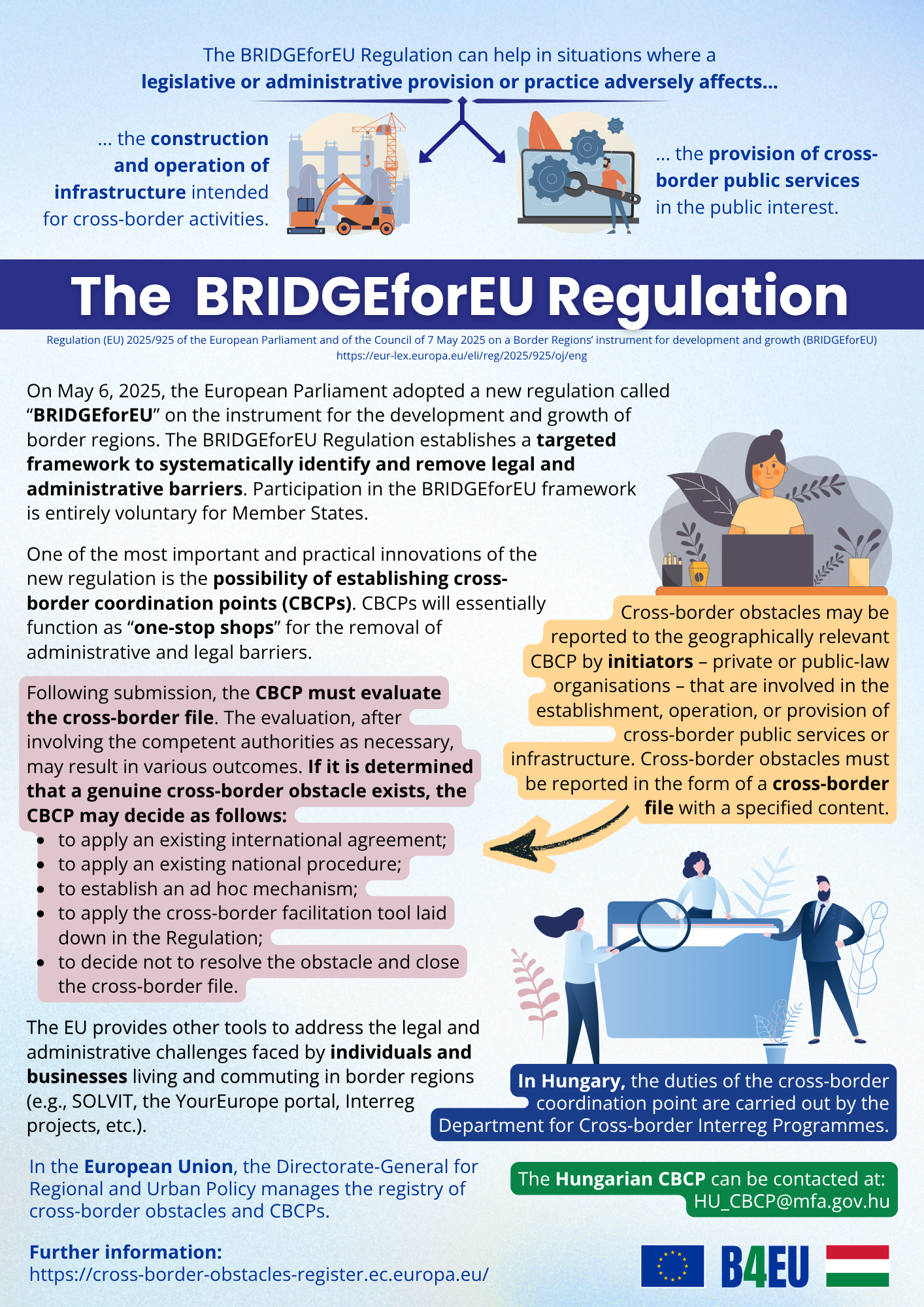
A new era in cross-border cooperation and the removal of administrative obstacles under the "BRIDGEforEU" Regulation.
Nearly one-third of the European Union's population - approximately 150 million people - live in border regions. Although the freedom of the single market theoretically ensures mobility, daily reality often shows otherwise. When accessing jobs, educational opportunities, healthcare, or housing available on the other side of the border, citizens and service providers face legal and administrative barriers generated by differing national legislation every single day. This issue is particularly important in Hungary: 15 out of 19 counties border another country, meaning nearly 80% of the population is considered to be living in border regions according to EU methodology.
The "BRIDGEforEU" Regulation: EU solution to everyday obstacles
To eliminate these structural disadvantages, the European Parliament adopted the new regulation, named "BRIDGEforEU", on May 6, 2025, establishing a development and growth instrument for border regions. This legislation is a historic milestone that provides Member States and cross-border actors with a direct tool to systematically identify and address administrative and legal obstacles hindering growth. This task is carried out by the Cross-Border Coordination Point (CBCP).
Hungary at the forefront: Domestic coordination point established
Among EU Member States, Hungary was the first to set up a coordination point. Behind this decision and rapid implementation lies a successful EU compromise negotiated during the Hungarian EU Presidency. The tasks of the domestic CBCP are performed by the Department for Cross-Border Interreg Programmes.
The role of the coordination point is to act as a single point of contact to receive notifications, categorise incoming problems by sector, and then contact the competent sectoral ministries and authorities - and, if necessary, the coordination point or relevant authority of the neighboring Member State - to initiate an investigation. Although the regulation does not make resolving a given obstacle mandatory, it provides a clear and official framework for decision-makers to meaningfully address issues arising in border areas.
How does the notification process work in practice?
If you are a representative of an organisation, institution or company operating cross-border infrastructure or services, and your activities are hindered by differing rules in a neighbouring country, you may submit an official notification to the CBCP in the form of a so-called ‘cross-border case file’. The coordination point will then initiate a professional and legal review of the obstacle with the competent national authorities.
International partnership and reaching out to neighboring countries
By its nature, cross-border mobility and economic development is a bilateral process. Just think of the more than 140,000 Hungarian workers employed in Austria, the over one thousand Hungarian children attending educational institutions there, or the thousands of Austrian, Slovak, and Romanian citizens who have moved to Hungarian border settlements! In addition, tens of thousands of workers living in neighboring countries contribute to the Hungarian national economy, and hundreds of Hungarian children from across the borders study in domestic schools, while the bilateral use of healthcare services and spending retirement years abroad are also showing a steadily growing trend. Furthermore, thanks to Interreg programmes, hundreds of developments and investments have been realised in our border regions in recent years.
For this reason, the Hungarian CBCP is currently actively seeking partners in neighboring countries - both in EU Member States and non-EU countries. Joint work and the networking of partner institutions are key to ensuring that the legal systems in force on both sides of the border do not hinder, but complement each other.
Contact and further information
If you are affected as a potential notifier, or if you wish to initiate partner cooperation as a representative of neighboring countries, please contact the Hungarian CBCP at its official email address: HU_CBCP@mfa.gov.hu.
If facilitating the daily lives of those living in border areas and cross-border commuters is important to you as well, you can count on our cooperation! Help the work of the Hungarian CBCP by reporting the obstacles you experience!