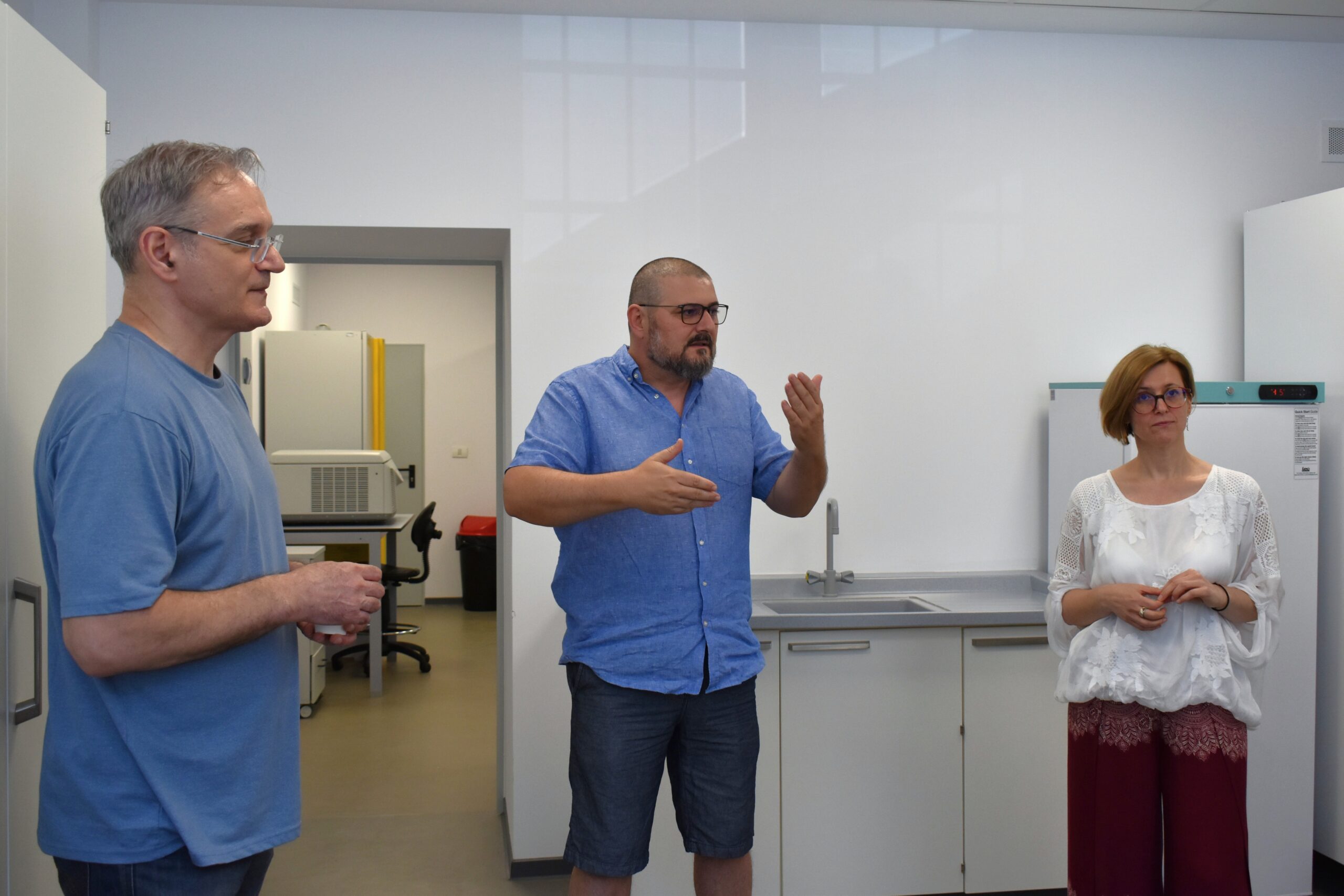
How Romanian and Hungarian researchers are helping doctors stay one step ahead of antimicrobial resistance
A patient arrives at the hospital with a severe infection. Doctors begin treatment, but they do not yet know which bacterium is responsible. Every hour counts. Somewhere, hidden within a tiny clinical sample, lies the answer that could change the patient's outcome.
Every year, millions of people around the world develop infections that antibiotics can no longer treat effectively. Romania is among the European countries most affected by antimicrobial resistance, one of the greatest threats to modern medicine.
Behind every statistic is a patient waiting for the right treatment – a patient whose recovery depends not only on the right medicine, but on receiving it before time runs out.
For doctors, every delayed diagnosis is a race against time. For researchers, it is a race against an invisible enemy.
Dr. Iulia PÎNZARU knows that race well.
As project manager of METAGEN | ROHU00049, a cross-border initiative funded by Interreg VI-A Romania–Hungary Programme, she spends her days navigating two very different worlds. One is filled with DNA sequencing, clinical samples and cutting-edge technology. The other is made up of procurement files, renovation plans and hundreds of administrative documents that most people will never see.
Both are essential if research is to save lives.
But as Dr. PÎNZARU is quick to point out, the story of METAGEN did not begin with the project itself.
"In many ways," she says, "it began with COVID-19."
During the pandemic, researchers at the Victor Babeș University of Medicine and Pharmacy in Timișoara learned something that would shape the years to come: how to read the genome of a pathogen quickly enough to answer urgent public health questions. Sequencing was no longer simply an advanced research technique. It had become an essential public health tool.
Among those leading the effort was Dr. Ovidiu SÎRBU, from the Department of Biochemistry.
Surprisingly, his career could have taken a very different direction.
“I dreamed of becoming a neurosurgeon until my sixth year of medical school, when I walked into a modern molecular biology laboratory,” he recalls with a smile. “It was love at first sight and the end of my neurosurgery career.”
From that moment on, molecular research became his true calling. Together with colleagues from the Department of Biochemistry and Microbiology, the team spent the pandemic developing expertise that few laboratories in Romania possessed. Long after the pandemic ended, they continued refining their methods, learning how to analyse increasingly complex clinical samples, improve sequencing accuracy and transform genetic data into information doctors could actually use.
By the time the first Interreg Romania–Hungary Call for Proposals was launched, the scientific expertise was already in place, developed and refined over years of research.
What did not yet exist was a place where all that knowledge could come together.
"There was no dedicated clinical metagenomics facility in Romania," Dr. PÎNZARU explains.
"I want to be precise about this because it is often repeated carelessly. It was never true that Romania had no metagenomics expertise. It was true that this expertise had nowhere to live at the scale it deserved."
METAGEN became the opportunity to change that.
Not simply by creating a state-of-the-art laboratory, but by bringing together expertise, infrastructure and cross-border cooperation around a challenge that, much like bacteria themselves, does not stop at national borders.
Building more than a laboratory
The first challenge, however, was not scientific; it was construction.
"I had prepared myself for complicated sequencing," Dr. PÎNZARU laughs. "I hadn't prepared myself for plaster."
For months, she found herself managing a construction site rather than a research project, dealing with architects, ventilation systems, technical ceilings and procurement procedures instead of laboratory experiments.
"Every European project is actually two projects running in parallel," she says. "There is the project everyone sees, the laboratory, the research, the results. And there is another project made entirely of documents. Nobody writes articles about that one."
Yet, without this behind-the-scenes work, research would not be possible.
Every procurement procedure completed and every construction milestone reached brought the team one step closer to creating something Romania had never had before: a dedicated Clinical Metagenomics Reference Centre.
On 17 December 2025, the renovation was officially completed.
Months ahead of schedule, the laboratory was ready. For the first time, the team could walk into a dedicated clinical metagenomics facility - no longer just drawings on paper, but a real place where research could unfold.
But the real breakthrough came later, on the day the first sample completed the entire workflow, from sample preparation to DNA sequencing and bioinformatic analysis. That was the moment METAGEN stopped being a construction project and became a working capability with real clinical applications.
"Until then," Dr. PÎNZARU reflects, "we had created sophisticated infrastructure. From that moment onward, we had a functioning capability with the potential to serve patients."
For her, that was the real milestone.
Not the completion of a building, but the moment when planning, construction, procurement and scientific preparation came together to create something capable of making a difference in a patient's life.
From technology to patients
Ask Dr. PÎNZARU to explain metagenomics, and she will not begin with sequencing, bioinformatics or sophisticated laboratory technologies.
She begins with a patient.
"When you develop a serious infection," she explains, "your doctor needs to know two things: what organism is causing it, and which medicine will kill it."
Today, finding those answers usually depends on growing bacteria in a laboratory. Sometimes that takes two days… sometimes five or even more.
Meanwhile, the patient cannot wait. Doctors begin treatment with the antibiotic most likely to work, relying on experience and clinical judgement.
Often, that decision saves lives. But when the bacteria are resistant and when the first treatment fails, precious time has already been lost.
METAGEN aims to reduce that waiting time dramatically. Instead of waiting for bacteria to grow in the lab before they can be identified, researchers analyse the genetic material directly from the patient’s sample.
Within hours, they can identify the pathogen and detect the resistance genes it carries. For clinicians, that means better information. For patients, it may mean receiving the right treatment sooner.
Why should people care about metagenomics?
Because antibiotics make much of modern medicine possible.
From surgery and cancer treatment to neonatal intensive care and everyday operations, countless medical procedures depend on them.
That is why the work being carried out in Timișoara and across the border, in Szeged, Hungary, is about much more than a new laboratory.
It is about helping doctors make better informed decisions, faster, so that patients have a better chance of receiving the right treatment when it matters most.
Because bacteria don't carry passports
Modern medicine has changed dramatically over the past century. Bacteria, however, have never cared about national borders.
For Dr. PÎNZARU, that simple reality explains why METAGEN could never have been a project confined to one laboratory, or even one country.
"Bacteria and resistance genes do not stop at the border. Patients cross it, food crosses it, water crosses it. A resistance map that stops on the Romanian side of the border is a map with a lie in it."
It is a striking image, but it is also a scientific reality.
Trying to understand antimicrobial resistance from only one side of the border means seeing only part of the picture.
That shared reality brought together researchers from the Victor Babeș University of Medicine and Pharmacy in Timișoara, the University of Szeged and the Oncohelp Association.
Each partner contributes something the others cannot provide alone.
The Romanian team is establishing the country's first dedicated Clinical Metagenomics Reference Centre, where advanced sequencing technologies allow specialists to identify pathogens and detect resistance genes directly from patient samples.
Across the border, at the University of Szeged, the project is modernising the Department of Medical Microbiology and the Institute of Laboratory Medicine. There, researchers specialise in therapeutic drug monitoring using mass spectrometry, measuring the concentration of antibiotics in a patient's bloodstream to determine whether treatment is actually reaching effective levels.
The OncoHelp Association is also involved in the project, providing access to a diverse and representative collection of clinical samples from cancer patients.
Together, these complementary strengths make it possible to answer two equally important questions.
What is causing the infection?
Is the treatment actually working for this patient?
"Genomics without pharmacology tells you what should work. The combination tells you what is working.", explains Dr. PÎNZARU
At first glance, that difference may sound technical.
For someone fighting a life-threatening infection, it could make all the difference.
When learning flows both ways
One of the project's biggest surprises came from its youngest researchers.
Years before METAGEN officially began, doctoral students in Timișoara had been working with Nanopore sequencing technologies, patiently building expertise that few laboratories in the region possessed.
When practical training sessions were organised with the Hungarian partner, Dr. PÎNZARU expected the learning to flow mainly in one direction.
Instead, she found herself watching the opposite happen.
"I had assumed that we would mainly be receiving expertise," she recalls. "Instead, our doctoral students were teaching our Hungarian colleagues how to prepare libraries and work with the platform."
For her, that moment represented something much greater than a successful training session. It showed that years of scientific work had created not only new technology, but also a new generation of researchers confident enough to share their knowledge internationally.
In many ways, that is what cross-border cooperation looks like at its best: Not knowledge flowing in one direction, but knowledge moving in both.
The legacy of cooperation
METAGEN officially concludes in January 2028.
Alone, it will not solve antimicrobial resistance; no single project can. Too many factors contribute to the problem: how antibiotics are prescribed, infection prevention in hospitals, agriculture, global travel and many others.
But it can ensure that one region of Europe is better prepared. It can help doctors make faster, better-informed decisions. It can leave behind expertise that continues to grow. And perhaps most importantly, it can ensure that cooperation does not end when the project does.
When asked what she hopes will be different five years from now, Dr. PÎNZARU pauses before answering, then she smiles.
"Not every challenge will be solved, but this region will no longer have to make these decisions blindly. "
It is a measured answer, not because it promises too little, but because it reflects the nature of scientific progress.
Real advances are rarely dramatic. They are built patiently, one discovery, one partnership and one shared lesson at a time.
Perhaps that is the real legacy of METAGEN. Not simply a new laboratory. Not simply new technologies. But a stronger community of researchers working together across disciplines, institutions and borders, better equipped to respond to one of the greatest health challenges of our time.
In the fight against an invisible enemy, that may prove to be one of the most important advances of all.
PROJECT AT A GLANCE
METAGEN | ROHU00049
Implementation: February 2025 – January 2028
Budget: €2.27 million (€1.81 million ERDF)
Project partners: Victor Babeș University of Medicine and Pharmacy Timișoara (Lead Partner), University of Szeged and Oncohelp Association
What is METAGEN?
METAGEN is helping Romania and Hungary strengthen their response to antimicrobial resistance by combining cutting-edge diagnostics with cross-border scientific cooperation.
The project is establishing Romania's first dedicated Clinical Metagenomics Reference Centre at the Victor Babeș University of Medicine and Pharmacy in Timișoara while modernising the Department of Medical Microbiology and the Institute of Laboratory Medicine at the University of Szeged.
Together, the partners are introducing advanced diagnostic technologies, training healthcare professionals, developing shared protocols and building a cross-border database of antimicrobial resistance genes to support faster, more informed treatment decisions.